

Ralph has gone on an overseas adventure to the continents of Africa and South America. Upon each of his visits to a different country, Ralph has written us a letter about his travels. However, Ralph has been quite 'Unreliable' again and has not told us the name of the country he is in. It is up to us to use the clues in the letter to try and find out where Ralph is.
UNRELIABLE RALPH ROAMs THE WORLD


COLUMBIA

Did you know..............................
Thousands of years ago, Colombia was nearly completely covered in jungle. But people have cleared most of the trees to create farmland, and now only a handful of areas have their original forests.Archaeologists think the first people to arrive in Colombia came about 20,000 years ago.
Fast Facts
Official Name: Republic of Colombia
Form of Government: Republic
Capital: Bogotá
Population: 44,379,598
Official Language: Spanish
Climate: Tropical; hot and wet along coasts and eastern plains, cooler in highlands
Money: Peso
Area: 1,138,910 sq km
Major Mountain Ranges: Andes, Sierra Nevada de Santa MartaMajor Rivers: Magdalena, Cauca, Atrato, Sinú
GEOGRAPHY
Colombia is nicknamed the "gateway to South America" because it sits in the northwestern part of the continent where South America connects with Central and North America.
It is the fifth largest country in Latin America and home to the world's second largest population of Spanish-speaking people.
Colombia is a land of extremes. Through its center run the towering, snow-covered volcanoes and mountains of the Andes. Tropical beaches line the north and west. And there are deserts in the north and vast grasslands, called Los Llanos, in the east.
Dense forests fill Colombia's Amazon Basin, which takes up nearly the country's entire southern half. In northwest Colombia, a warm, wet, jungle-filled area called the Chocó reaches across the Panama border.
NATURE
With its vast rain forests, sprawling savannas, huge mountains 2,900 kilometers of coastline on two oceans, Colombia is one of the most biologically diverse countries on Earth.
Even though it takes up less than one percent of the world's land area, about 10 percent of all animal species live in Colombia.
Much of Colombia's forest habitats have been undisturbed for many millions of years. This has given wildlife a chance to evolve into many different species.
Animals from jaguars to caimans to poison dart frogs all call Colombia's jungles home. The mountains provide habitat for huge Andean condors and rare spectacled bears, South America's only bear species.
Thousands of years ago, Colombia was nearly completely covered in jungle. But people have cleared most of the trees to create farmland, and now only a handful of areas have their original forests. The government has set up several national parks to protect habitats, but damage to the environment continues.


PEOPLE AND CULTURE
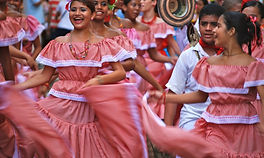
Colombia's people are as varied as its landscape. Most citizens are descended from three ethnic groups: Indians, African people brought to Colombia to work as slaves, and European settlers. This rich cultural mix makes the country's foods, music, dance, and art diverse and unique.
GOVERNMENT AND ECONOMY
Colombia has a long history of democracy. Like the United States, the country is run by a president, who is elected every four years. Laws are made by a House of Representatives and a Senate.
Colombia's biggest trading partner is the United States, which buys 40 percent of the country's exports. Colombia sends a variety of items overseas, including coffee, bananas, oil, coal, gold, platinum, and emeralds.
One of Colombia's worst exports, though, is illegal drugs. With help from the United States, the Colombian government is carrying out Plan Colombia, a costly and wide-ranging effort to rid the country of the gangs, called cartels, that produce illegal drugs for sale around the world.


SUSTAINABILITY
Colombia's rate of deforestation of humid tropical forest is among the world's five highest
Clearing for illicit crops (along with the expansion of the agricultural frontier, with new settlements and extensive cattle ranching) is one of the principal causes of deforestation in the Colombian Amazon.
Coca has been a boom crop in Colombia since the mid-1970s. External demand for coca, combined with a drop in coca-growing in other countries, has driven up the extent of Colombian land under coca from 37 500 ha in early 1991 to more than 100 000 ha in 1999.
From a purely economic point of view, such illicit crops could be regarded as the most profitable rural economic activity in Colombia; they can generate far higher earnings for peasant growers than legitimate crops, therefore seeming to provide a possible answer to the poverty and marginalization of so many peasant farmers.
However, coca has had a deleterious impact, not only on the Amazon forest, but also on the food security of the inhabitants of the Amazon region where most of Colombia's coca crop is grown. Growers typically derive the least profit from the crop, and poverty and malnutrition have risen with the coca boom as a result of the inflationary effect of these activities on weak local economie.
SEARCH FOR ALTERNATIVES
The government attempted to eradicate illicit crops by aerial spraying of herbicides, which had a significant negative effect on surrounding forest vegetation and which can be toxic for human beings.
This has had an adverse effect not only on legitimate crops, but also on the forest and on water supplies.
What the country needs is a policy aimed at reweaving the social fabric of a free peasantry. A culture of non-violence must be strongly promoted. Production systems and relationships harmful to social well-being and the environment cannot be transformed without a prior and major transformation of culture and values. A society lacking in solidarity and respect for human life cannot make a peace pact with nature.

